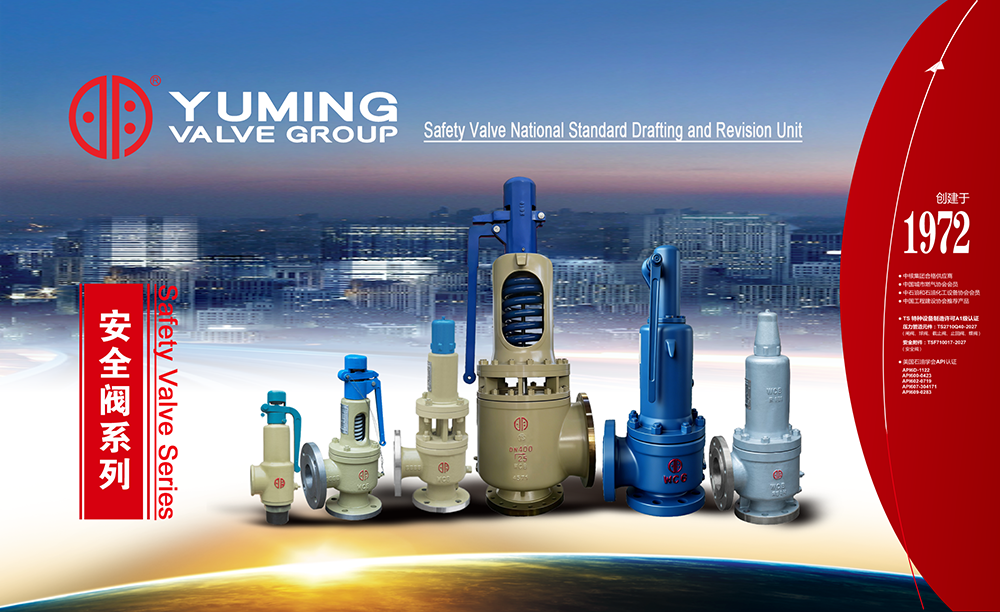
In various pressure systems used in industrial production, if the internal pressure exceeds the maximum allowable working pressure of the equipment, it may lead to serious accidents such as container rupture, medium leakage, or even explosion. A safety valve is a core device designed to prevent such risks. It automatically opens to relieve pressure when the pressure reaches a preset threshold and closes by itself once the pressure drops back to a safe range, thereby ensuring the stable operation of pressure equipment and the entire production process.
Safety valves have a wide range of application scenarios. They need to be installed in any system or pressure-containing vessel where there is a risk of overpressure. In steam systems, safety valves are often used for overpressure protection of boilers and also installed downstream of pressure reducing control devices. Their core function is to ensure safety, and in many process productions, they also prevent product damage caused by excessive pressure.
Overpressure can occur in various situations, such as process operation errors, equipment failures, and thermal expansion of the medium. In such cases, the timely response of the safety valve is particularly important.
The primary function of a safety valve is to provide overpressure protection. When the internal pressure of the pressure system rises abnormally and reaches the set opening pressure of the safety valve, the valve opens quickly to discharge excess medium, preventing malignant accidents such as system rupture or explosion due to overpressure.
For process production, safety valves can maintain the operational stability of the system. In the event of process fluctuations, fire hazards, or upstream equipment failures, safety valves can relieve pressure in a timely manner to prevent sudden local pressure increases from affecting the normal progress of the entire production process and reduce economic losses caused by equipment shutdowns.
In addition, safety valves are key equipment for industrial enterprises to meet compliance requirements. Pressure systems in different industries have corresponding safety specifications, and installing and using safety valves correctly is a necessary condition for enterprises to comply with these specifications and pass safety audits.
Safety valves can be classified in many ways. According to the lift height of the disc, they are mainly divided into three categories: low-lift safety valves, full-lift safety valves, and full-bore safety valves.
The discharge area of a low-lift safety valve is determined by the actual opening position of the disc. The disc has a small lift height, and its pressure relief capacity is relatively limited, making it suitable for working conditions with low overpressure risks. The discharge area of a full-lift safety valve is independent of the disc position. The disc can achieve a large lift height, resulting in higher pressure relief efficiency, which is suitable for scenarios requiring rapid and large-volume pressure relief.
A full-bore safety valve has no protruding structures in its internal passage. After the valve opens, the minimum cross-sectional area at and below the valve seat becomes the throttling port that controls the flow rate. This design allows the medium to pass through more smoothly and reduces flow resistance.
According to their structure and working principle, safety valves can be further divided into conventional safety valves, balanced safety valves, pilot-operated safety valves, and power-actuated safety valves.
The spring chamber of a conventional safety valve is connected to the discharge side, so changes in backpressure directly affect the valve's operational performance. In working conditions with large backpressure fluctuations, additional backpressure compensation measures need to be considered. Through a special structural design, balanced safety valves can minimize the impact of backpressure on the valve's operational characteristics, making them suitable for complex working conditions with frequent backpressure changes.
A pilot-operated safety valve consists of a main pressure relief device and a self-actuated auxiliary pressure relief device. The auxiliary device controls the opening and closing of the main valve based on changes in system pressure, resulting in higher response accuracy. Power-actuated safety valves require external energy sources to control the opening and closing of the main pressure relief device, making them suitable for scenarios with special control requirements for valve opening and closing.
In the oil, gas, and petrochemical industry, the safety protection of pressure equipment is a top priority. All types of pressure-bearing pipelines, separators, and storage tanks need to be equipped with reliable pressure safety valves.
In the upstream extraction link, safety valves must handle crude oil and natural gas media containing a large amount of particulate matter, which imposes high requirements on the wear resistance and impact resistance of the valves. In the downstream refining link, equipment such as distillation columns experience severe fluctuations in temperature and pressure during operation. Safety valves need to work stably under complex working conditions to prevent equipment damage due to overpressure.
The core role of these safety valves is to prevent system rupture and reduce the probability of safety accidents in extreme situations such as process fluctuations or fires.
The operation of power plants cannot do without reliable overpressure protection measures, and boiler safety valves are the last line of defense for the entire system.
The water inside the boiler drum generates a large amount of steam after being heated, resulting in a sharp expansion in volume. Safety valves installed on the boiler drum can discharge excess steam in a timely manner to control the internal pressure stably. The superheater is a key piece of equipment in a power plant. Once the main steam flow is interrupted, the temperature of the medium inside the superheater tubes will rise rapidly. Specialized safety valves can prevent the superheater from tube bursting due to over-temperature and overpressure.
In such application scenarios, the design and selection of safety valves must strictly comply with the relevant specifications in ASME Section I to ensure effective control of steam accumulation.
The production environments of the chemical and pharmaceutical industries are special, imposing strict requirements on the material compatibility and hygienic performance of safety valves. Balanced bellows safety valves or specialized safety relief valves are usually selected.
In chemical production, various corrosive media are often encountered, so safety valves made of special alloy materials need to be used to prevent valve failure due to corrosion by the medium. The production process in the pharmaceutical industry has extremely high requirements for hygienic conditions, so flush-mounted sanitary safety valves must be used to avoid medium residue and bacterial growth, which could affect drug quality.
At the same time, for the handling of toxic media, safety valves must achieve zero-leakage discharge to prevent toxic substances from diffusing into the atmosphere and ensure the personal safety of operators.
Beyond large-scale processing plants, safety valve technology is also widely used in marine and general manufacturing fields.
On ships, safety valves are mainly used to protect ship boilers and cargo storage and transportation systems, addressing the issue of medium thermal expansion caused by changes in ambient temperature during navigation. In high-pressure water cleaning systems, safety valves can prevent excessive system pressure and avoid equipment damage.
On some general air receivers and utility pipelines, although the role of safety valves seems simple, they provide stable overpressure protection for these basic equipment, ensuring the smooth progress of daily production.
The selection and sizing of safety valves are critical links to ensure their proper functioning. Either undersized or oversized valves will affect the effectiveness of overpressure protection. An undersized safety valve has insufficient pressure relief capacity and cannot reduce the pressure to a safe range within the specified time. An oversized safety valve, on the other hand, increases equipment costs and may cause frequent opening and closing of the valve.
When determining the relief capacity of a safety valve, it is necessary to comprehensively consider the medium flow rate in all relevant upstream branches of the valve. When there are multiple possible medium flow paths in the system, sizing the safety valve becomes more complex, and two common calculation methods are usually adopted.
The first method is sizing based on maximum flow rate. This method determines the size of the safety valve according to the flow path with the highest flow rate among all flow paths, ensuring that the valve can handle the most extreme flow conditions. The second method is sizing based on combined flow rate. When there is a risk of simultaneous failure of multiple devices in the system, the size of the safety valve needs to be calculated based on the total relief capacity of all failed devices to prevent overpressure caused by excessive total relief capacity.
The choice between these two sizing methods mainly depends on the enterprise's risk assessment results and cost considerations. If the probability of simultaneous failure of multiple devices is extremely low, sizing the valve based on the maximum fault flow rate is sufficient to meet the requirements. However, if there is a possibility of multiple failures, the combined flow rate calculation method must be adopted to ensure that the safety valve can handle the total relief capacity.
Ultimately, the enterprise responsible for plant operation decides which method to use, while complying with relevant safety standards and risk assessment requirements. Only when the selection and sizing of safety valves are accurate can the risk of overpressure accidents be minimized, and the overall safety and reliability of the system be improved.
As key safety equipment, the design, manufacturing, and inspection of safety valves must comply with corresponding standards and specifications. Different countries and regions have formulated standards suitable for local industrial needs.
Relevant standards in Germany include AD Merkblatt A2, TRD 421, and TRD 721. Among them, TRD 421 applies to safety valves for boilers of Groups I, II, and IV, while TRD 721 is specifically applicable to safety valves for Group II steam boilers. The British standard BS 6759 is divided into three parts, which specify requirements for safety valves used with steam and hot water, compressed air and inert gases, and process fluids, respectively.
French standards AFNOR NFE-E 29-411 to 416 and NFE-E 29-421 are general specifications for safety valves and relief valves. The Korean standard KS B6216 and the Japanese standard JIS B 8210 both apply to spring-loaded safety valves for steam boilers and pressure vessels. The Australian standard SAA AS1271 covers requirements for safety valves, other valves, liquid level gauges, and other accessories used in boilers and unfired pressure vessels.
The relevant standard system in the United States is relatively comprehensive. ASME I applies to boiler applications, ASME III targets equipment related to nuclear facilities, and ASME VIII is used for unfired pressure vessels. API RP 520 is divided into two parts, which specify the selection, sizing, and installation requirements for pressure relief devices in refineries. API RP 521 is a design guide for pressure relief and depressurization systems. API STD 526 and API STD 527 specify requirements for flanged steel pressure relief valves and the seat tightness of pressure relief valves, respectively.
In terms of international standards, EN ISO 4126 is a general standard for safety devices against excessive pressure, and ISO 4126 specifies general requirements for safety valves. These standards provide a unified technical basis for the global application of safety valves.
|
Valve size DN |
15/20 |
20/32 |
25/40 |
32/50 |
40/65 |
50/80 |
|
Area (mm²) |
113 |
314 |
452 |
661 |
1075 |
1662 |
|
Set pressure (bar g) |
Flow capacity for saturated steam (kg/h) |
|||||
|
0.5 |
65 |
180 |
259 |
379 |
616 |
953 |
|
1 |
87 |
241 |
348 |
508 |
827 |
1278 |
|
1.5 |
109 |
303 |
436 |
638 |
1037 |
1603 |
|
2 |
131 |
364 |
524 |
767 |
1247 |
1929 |
|
2.5 |
153 |
426 |
613 |
896 |
1458 |
2254 |
|
3 |
175 |
487 |
701 |
1026 |
1668 |
2579 |
|
3.5 |
197 |
549 |
790 |
1155 |
1879 |
2904 |
|
4 |
220 |
610 |
878 |
1284 |
2089 |
3230 |
|
4.5 |
242 |
672 |
967 |
1414 |
2299 |
3555 |
|
5 |
264 |
733 |
1055 |
1543 |
2510 |
3880 |
|
5.5 |
286 |
794 |
1144 |
1672 |
2720 |
4205 |
|
6 |
308 |
856 |
1232 |
1802 |
2930 |
4530 |
|
6.5 |
330 |
917 |
1321 |
1931 |
3141 |
4856 |
|
7 |
352 |
979 |
1409 |
2061 |
3351 |
5181 |
|
7.5 |
374 |
1040 |
1497 |
2190 |
3561 |
5506 |
|
8 |
396 |
1102 |
1586 |
2319 |
3772 |
5831 |
The installation position of a safety valve directly affects its working effect. The installation location must be carefully selected to prevent pressure accumulation in the system.
If the supply pressure of the pressure relief valve equipped for a single piece of equipment is higher than the maximum allowable working pressure of the equipment, a separate safety valve must be installed for that equipment. When a single pressure relief valve supplies medium to multiple pieces of equipment, if the maximum allowable working pressure of any piece of equipment is lower than the supply pressure of the pressure relief valve, there are two solutions. One is to install a safety valve at the pressure relief valve station, with the set pressure of the safety valve determined based on the lowest maximum allowable working pressure of the connected equipment. The other is to install a separate safety valve for each affected piece of equipment.
When determining the installation position of the safety valve, it is also necessary to consider whether there are other paths that may cause pressure accumulation in the equipment, such as independent fluid pipelines or bypass pipelines, to ensure that the safety valve can effectively monitor and relieve the overall pressure of the equipment.
The maintenance of safety valves is equally important. It is recommended to conduct maintenance checks on safety valves in heating systems every six months. During maintenance, it is necessary to measure the opening pressure, full-opening pressure, and closing pressure of the valve, and check for medium leakage after the valve seats back on the valve seat.
If deviations between these pressure parameters and the set values are found during maintenance, the cause of the deviation must be identified and eliminated in a timely manner, followed by verification tests on the safety valve to ensure its performance meets the requirements. If the safety valve is designed with a lifting handle, it will greatly simplify the maintenance of the valve and the inspection of valve seat tightness. It should be noted that it is strictly prohibited to open a stuck safety valve by prying with a lever or striking with a hammer, as such operations may cause the valve to open suddenly, leading to valve damage.
When a safety valve experiences issues such as leakage, failure to open normally, incomplete opening, or failure to close normally, it needs to be repaired. The structure of safety valves is relatively simple, so maintenance personnel can diagnose and repair faults in an ordinary mechanical workshop without the need for special equipment.
In practical applications, the types of safety valve faults are relatively concentrated. Leakage, simmering (pre-opening), and frequent popping account for 90% of maintenance requests.
Leakage is mostly caused by debris trapped between the valve seat and the disc, or valve misalignment due to pipeline stress. If leakage is not addressed in a timely manner, the high-velocity flowing medium will form grooves on the sealing surface (commonly known as "wire drawing"), leading to permanent damage to the valve's sealing performance.
Simmering (pre-opening) refers to the phenomenon where the safety valve produces an audible sound or opens slightly before reaching the set pressure. The main cause of this problem is that the operating pressure of the system is too close to the set pressure of the safety valve. Generally, a pressure difference of at least 10% must be maintained between the operating pressure and the set pressure to avoid simmering.
Frequent popping indicates that the protection pressure threshold of the pressure vessel is being triggered frequently, which is usually caused by faults in the upstream process control link. In such cases, consideration can be given to replacing the globe control valve with a higher-performance one to improve the pressure control accuracy of the upstream process and reduce the frequent popping of the safety valve.
Safety valves are indispensable safety devices in industrial pressure systems. Every link, including their selection, installation, and maintenance, is directly related to the safety of equipment and personnel. Understanding the basic principles, types, and application characteristics of safety valves, and conducting proper daily maintenance and fault troubleshooting, can ensure that safety valves truly play their role as "safety guards".
If your enterprise has questions about the selection or maintenance of safety valves, you may consult professional technicians to select appropriate solutions based on actual working conditions and build a solid defense for production safety.