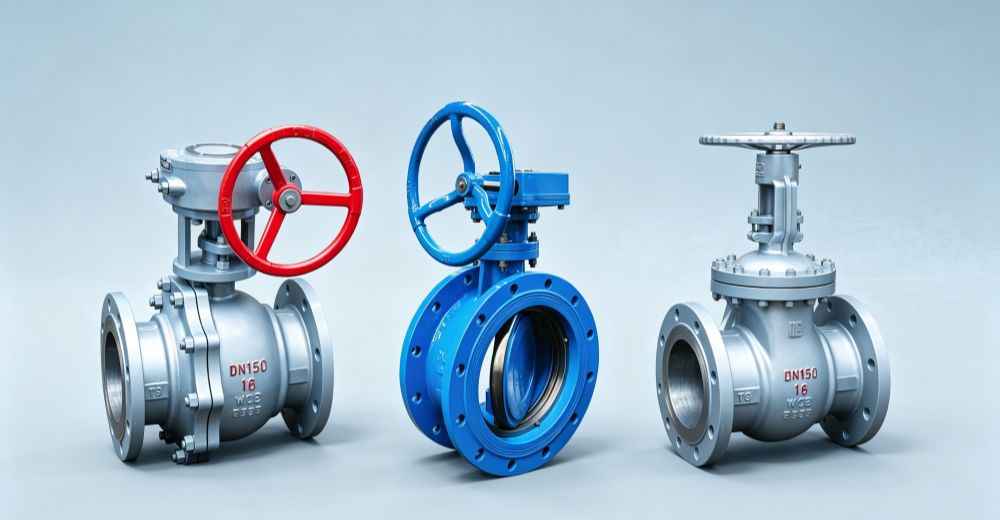
Ball Valve vs Butterfly Valve vs Gate Valve for Chemical Pipelines
2026-07-24
Selecting the right valve is one of the most important decisions in chemical plant design. A poor valve choice can lead to leakage, increased maintenance costs, production downtime, or even serious safety risks.
Among industrial valves, ball valves, butterfly valves, and gate valves are the three most commonly used isolation valves. Although they all perform on/off functions, their working principles and applications are very different.
1.Ball Valves: The First Choice for Small and Medium Chemical Pipelines
Ball valves use a rotating spherical ball with a bore to achieve quick shut-off.
Key Advantages
·Excellent bubble-tight sealing
·Quarter-turn operation
·Fast opening and closing
·Low pressure drop
·Minimal maintenance
·Suitable for automation
Because of these benefits, ball valves are widely used for:
·Chemical transfer lines
·Oil pipelines
·Gas systems
·Solvent handling
·Instrument isolation
·Process automation
·Best Applications
Ball valves are ideal when:
·Zero leakage is critical
·Frequent operation is required
·Fast emergency shut-off is needed
·Medium viscosity fluids are transported
For many chemical plants, ball valves have become the standard solution for pipeline isolation.
2.Butterfly Valves: The Economical Solution for Large Diameter Pipelines
Butterfly valves regulate flow using a rotating disc positioned in the center of the pipeline.
Their biggest advantage is their compact structure.
Compared with ball valves of the same size, butterfly valves are:
·Much lighter
·More compact
·Easier to install
·More cost-effective in large diameters
·Typical Applications
Butterfly valves are commonly selected for:
·Cooling water systems
·Seawater pipelines
·Utility services
·Large-diameter chemical pipelines
·Offshore platforms
In pipeline sizes above DN300 (12 inches), butterfly valves often provide significant savings in installation and equipment costs.
Limitations
Although modern triple-offset butterfly valves offer excellent sealing performance, standard butterfly valves are generally less suitable for applications requiring absolute zero leakage under severe operating conditions.
3.Gate Valves: Reliable Performance in High-Temperature and High-Pressure Service
Gate valves isolate flow by lifting a gate completely out of the flow path.
When fully open, they provide:
·Full-bore flow
·Very low pressure loss
·Excellent high-pressure capability
·Best Applications
Gate valves remain a preferred solution for:
·Steam systems
·Thermal power plants
·High-temperature pipelines
·High-pressure process lines
·Boiler applications
Limitations
1)Gate valves require multiple turns to operate, making them slower than quarter-turn valves.
2)They are also generally larger and heavier than ball valves and butterfly valves.
3)For applications requiring rapid emergency shut-off, gate valves are usually not the preferred option. 4.Which Valve Should You Choose?
There is no universal valve for every application. Instead, selection should be based on operating conditions.
Choose a Ball Valve if:
·Tight shut-off is essential
·You need fast operation
·The process requires frequent switching
·Chemical leakage must be minimized
Choose a Butterfly Valve if:
·The pipeline diameter is large
·Installation space is limited
·Budget is a major consideration
Choose a Gate Valve if:
·The system operates under very high pressure
·High temperatures are present
·Full-port flow is required
In conclusion
In harsh chemical environments, choosing the right valve directly affects plant safety, operational efficiency, and maintenance costs.
As a general guideline:
·Ball valves are the preferred choice for small- to medium-sized pipelines requiring reliable sealing and fast operation.
·Butterfly valves are the most economical solution for large-diameter, low- to medium-pressure systems where weight and installation costs matter.
·Gate valves remain the best option for high-temperature and high-pressure applications such as steam and power systems.
Understanding the strengths of each valve type allows engineers to design safer, more efficient, and more reliable piping systems that perform well throughout their service life.