Industrial Butterfly Valve Working Principle, Components & Types
2026-08-28
1. What is a butterfly valve?
Butterfly valve is a common type of rotary valve.
Its core opening and closing component is a disc-shaped butterfly plate.
The butterfly plate is installed inside the valve body and rotates through the valve stem.
When the butterfly plate is parallel to the direction of the pipe, the medium can pass through and the valve opens.
When the butterfly plate rotates 90° and is perpendicular to the direction of the pipe, the medium is blocked and the valve closes.
So the core action of the butterfly valve is: the butterfly plate rotates 90°
Butterfly valves are commonly used for:
·Circulating water pipeline
·Cooling water pipeline
·Fire water pipeline
·Low pressure gas pipeline
·Ventilation ducts
·Large diameter process pipeline
·Sewage pipeline
·Partial steam and high temperature conditions
The biggest features of butterfly valves are: short structure, light weight, and suitable for large diameters.
2. Basic structure of butterfly valve
1) Valve body
The valve body is the main body of the butterfly valve.
It is connected to the pipeline and bears the medium pressure.
Butterfly valve bodies are usually shorter, so butterfly valves are often said to have short structural lengths.
Common connection methods are:
·Clamp type
·Flange type
·Lug type
·Welded type
Common ones at chemical industry sites are:
·Wafer butterfly valve
·Flange butterfly valve
2) Butterfly plate
The butterfly plate is the opening and closing part of the butterfly valve.
It is like a disc and is installed inside the valve body.
When the butterfly plate rotates, the flow area is changed, thereby controlling the passage or cutting of the medium.
Common materials for butterfly plates include:
·Carbon steel
·Stainless steel
·Cast iron
·Nodular cast iron
·Rubber lining
·Fluorine lined
·Alloy material
If the butterfly plate is deformed, corroded or the sealing edge is damaged, the valve may not close tightly.
3) Valve stem
The valve stem connects the handle, worm gear box or actuator and butterfly plate.
The valve stem transmits external operating force to the butterfly plate.
Common valve stem problems include:
·Bend
·Wear and tear
·Break
·Leakage from the seal
·Loose connection with butterfly plate
4) Valve seat
The valve seat cooperates with the edge of the butterfly plate to form a seal.
Whether the butterfly valve is tightly closed mainly depends on:
·Butterfly sealing edge
·Valve seat sealing surface
·Stem position
·Is the butterfly plate in place?
Common materials for valve seats include:
·Rubber
·EPDM
·NBR
·PTFE
·Metal hard sealing material
5) Handle and worm gear box
Small diameter butterfly valves are commonly operated by handles.
Medium and large diameter butterfly valves are commonly operated with worm gear boxes.
Because the butterfly plate of a large-diameter butterfly valve is subject to a large force from the medium, it will be more laborious to operate it directly with the handle.
The worm gear box can reduce the operating torque and make the switch smoother. 3. Working principle of butterfly plate rotation
The working principle of butterfly valve is relatively intuitive.
The core is: the rotation of the butterfly plate changes the flow channel area.
1) Fully open state
When the butterfly plate is basically parallel to the direction of the pipe, the valve is in a fully open state.
The medium can flow through both sides of the butterfly plate.
But be careful:
Even if the butterfly valve is fully open, the butterfly plate is still in the center of the pipe.
Therefore, when the butterfly valve is fully open, the flow resistance is usually larger than that of the ball valve and gate valve.
2) Fully closed state
When the butterfly plate rotates 90° and is perpendicular to the direction of the pipe, the butterfly plate blocks the flow channel.
The edge of the butterfly plate and the valve seat form a seal. The valve is closed.
If the butterfly plate is not in place, the valve seat is damaged, or the edge of the butterfly plate is worn, internal leakage will occur.
3) Half-open state
Butterfly valves can change the flow area by changing the angle of the butterfly plate. Therefore, the butterfly valve has certain adjustment capabilities.
However, ordinary butterfly valves are not suitable for long-term use under conditions of small opening and high pressure difference.
Long-term small opening may cause:
·Butterfly scour
·Valve seat wear
·Vibration
·Noise
·Cavitation
·Unstable adjustment
If stable adjustment is required, a special regulating butterfly valve or regulating valve should be selected.
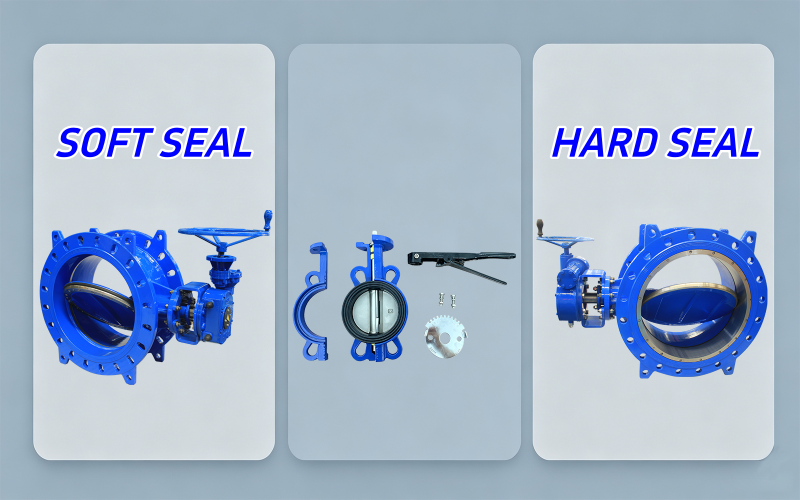
4. Soft sealing butterfly valve and hard sealing butterfly valve
Butterfly valves can be divided into:
·Soft seal butterfly valve
·Hard seal butterfly valve
1) Soft seal butterfly valve
Soft sealing butterfly valves usually use non-metallic materials such as rubber or PTFE as the valve seat.
Common materials include:
·EPDM
·NBR
·PTFE
·Rubber lining
·Fluoroplastic lining
Advantages:
·Good sealing performance
·Lower cost
·Small opening and closing torque
·Suitable for low pressure water systems
·Resistant to some corrosive media
Disadvantages:
·Not resistant to high temperatures
·Not resistant to strong erosion
·Not suitable for media containing hard particles
·The valve seat is prone to aging
·Limited pressure and temperature range
Commonly used for:
·Circulating water
·Cooling water
·Firefighting water
·Low pressure air
·Sewage
·Some corrosive media
2) Hard seal butterfly valve
Hard-sealed butterfly valves adopt a metal sealing structure and are common in double-eccentric or triple-eccentric butterfly valves.
Advantages:
·High temperature resistance
·High pressure resistance
·Erosion resistant
·Wear resistance
·Long life
·Suitable for steam and hot oil working conditions
Disadvantages:
·Higher cost
·High manufacturing precision requirements
·High maintenance requirements after sealing surface damage
·Sealing performance under low pressure may be affected by structure
Commonly used for:
·Steam
·Hot oil
·High temperature gas
·High pressure pipeline
·Contains slightly granular media
·Strictly cut off situations
5. Summary
Butterfly valve is a common large-diameter valve in chemical industry sites.
Its core principle is: the butterfly plate rotates 90° to control the on and off of the medium.
When using butterfly valves on site, you must remember:
Butterfly valves are suitable for large diameter, low pressure, and large flow situations, but ordinary butterfly valves are not suitable for long-term small opening and high pressure difference adjustment.
If used for high-temperature steam, hot oil or strict isolation conditions, priority should be given to hard-sealed butterfly valves.