API Ball Valves: Harsh Working Conditions of Chemical Plant
2026-01-12
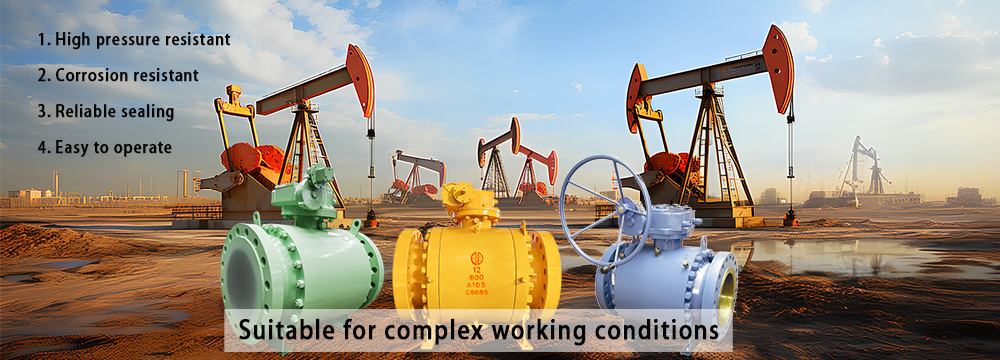
API Ball Valves: Core Control Solutions for Harsh Working Conditions of Chemical Plant Our company's API 6D standard ball valves are also used throughout the entire process of exploration, extraction, gathering, transportation, and refining in the oil industry. Leveraging their structural characteristics and standard specifications, they have become core valves suitable for harsh working conditions such as high pressure, high sulfur content, and high impurities. Specific advantages include: I. High Opening and Closing Efficiency, Adapting to Rapid Oil and Gas Cut-off Needs 90° Rotation Opening and Closing: The valve stem only needs to rotate 90° to complete the fully open/fully closed action, with an opening and closing time of only a few seconds. In emergency shut-off of long-distance oil pipelines (such as in leakage or fire situations), it can quickly cut off the medium, significantly reducing accident losses. Low Operating Torque: The small contact area between the ball and the medium, and the valve seat mostly using self-lubricating materials (such as PTFE, reinforced polytetrafluoroethylene), allow for easy operation even under high pressure (Class 2500LB) and large diameter (DN1000 and above) conditions via manual, electric, or pneumatic actuators, reducing maintenance costs. II. Superior Sealing Performance, Eliminating Leakage of High-Risk Media Bidirectional Zero-Leakage Seal: The API 6D ball valve employs a floating or fixed ball structure, combined with a resilient seat design. The medium pressure pushes the seat tightly against the ball, forming a self-tightening seal, achieving Class VI sealing (near-zero leakage). This fully meets the sealing requirements of the petroleum industry for highly toxic/flammable and explosive media such as crude oil, natural gas, and hydrogen sulfide. Fireproof and Anti-static Design: Compliant with API 607/6FA fireproof standards, the valve seat has a built-in fireproof sealing structure. Even if a fire causes the non-metallic seals to fail, the metal secondary seal can still prevent medium leakage. Simultaneously, an anti-static device is installed between the valve stem and the ball to avoid the risk of combustion and explosion caused by static electricity accumulation, making it suitable for high-risk scenarios in oil and gas fields. III. Strong Resistance to Harsh Working Conditions, Adaptable to the Entire Petroleum Process Environment Wear and Erosion Resistance: The ball and seat surfaces can be overlaid with hard materials such as Stellite alloy and tungsten carbide, which can withstand the erosion and wear of solid particles such as sand, wax, and asphalt in oil and gas. In oil and gas field gathering and transportation pipelines, its service life far exceeds that of ordinary valves. Sulfur and Corrosion Resistance: The valve body can be made of sulfur-resistant carbon steel (such as A105N), stainless steel (CF8M), or duplex steel (2205), meeting the NACE MR0175 sulfur resistance standard. It can operate stably in high-sulfur oil and gas fields (H₂S partial pressure > 0.0003MPa), preventing stress corrosion cracking. Wide Temperature Range Adaptability: It can operate normally within a temperature range of -50℃ (oil and gas gathering and transportation in cold regions) to 150℃ (high-temperature media in refining). The seat material has strong thermal stability and will not cause sealing failure due to sudden temperature changes. IV. Compact Structure, Convenient Maintenance, and Adaptability to Complex Pipeline Networks Small Size and Light Weight: Compared to API 600 gate valves of the same diameter, API 6D ball valves can reduce size and weight by 30%~50%, saving pipeline installation space, making them particularly suitable for site-constrained scenarios such as offshore platforms and desert oil fields. Good Online Maintainability: Most API 6D ball valves adopt a side-mounted or top-mounted structure, allowing for online replacement of vulnerable parts such as valve seats and packing without disassembling the valve body and pipeline. Maintenance time is reduced from several hours for traditional valves to 1~2 hours, minimizing downtime losses in oil and gas production.