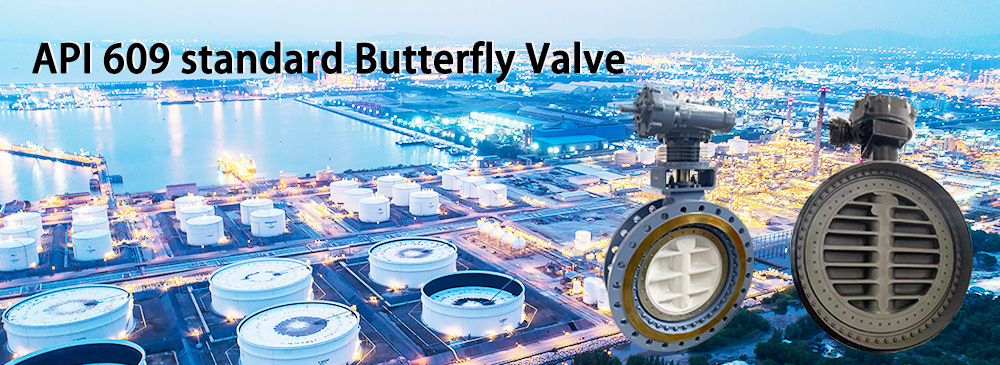
Applications of API 609 Butterfly Valves in the Petroleum and Chemical Industries
2025-12-30
Applications of API 609 Butterfly Valves in the Petroleum and Chemical Industries API 609 standard butterfly valves (including double-eccentric and triple-eccentric structures) are the preferred valves for large-diameter, low-pressure to medium-pressure applications in the petroleum and chemical industries due to their compact structure, low flow resistance, and flexible opening and closing. They are widely used in media transportation, system isolation, and flow regulation, and are particularly suitable for scenarios involving particulate or viscous media. I. Core Applicable Conditions and Scenarios (I) Petroleum Industry Application Scenarios Suitable for oil and gas gathering and transportation pipelines, including crude oil and natural gas mixed transportation pipelines (pressure class 150~300LB, diameter DN300~DN2000), used for branch line disconnection and pigging ball control. Advantages: The triple-eccentric metal hard-seal butterfly valve can withstand the erosion of sand and wax in oil and gas, and its 90° rapid opening and closing characteristic allows for efficient process switching during pigging operations. Case Study: In October 2023, our company supplied an oil transportation pipeline project in Heilongjiang Province, selecting API 609 triple eccentric butterfly valves to replace traditional large-diameter gate valves. This reduced equipment weight by 40%, installation costs by 30%, and resulted in 24 months of continuous operation without leakage. (II) Chemical Industry Application Scenarios Chemical media transportation pipelines are suitable for the transportation and shut-off of media such as acid and alkali solutions, solvents, and slurries, such as caustic soda solution pipelines in caustic soda plants and ammonia dilution circuits in fertilizer plants. Advantages: Valve bodies can be made of 316L stainless steel or PTFE-lined materials, offering excellent corrosion resistance; soft-seal butterfly valves can achieve Class IV sealing, meeting the low leakage requirements for toxic media. Reaction vessel supporting systems are used for feed buffering, tail gas venting, and cooling water regulation in reaction vessels, especially suitable for high-flow-rate, low-pressure-loss regulation needs. Advantages: The regulating API 609 butterfly valve has a regulation ratio of up to 50:1, enabling precise control of cooling water flow and stable reactor temperature; its compact structure makes it suitable for installation in confined spaces within the reaction zone. The nitrogen sealing system in the tank area is used for pressure control and gas supply cutoff of the nitrogen seal in the tanks, ensuring that the media (such as gasoline and methanol) inside the tanks are not oxidized, while preventing overpressure leakage. Advantages: Low opening and closing torque, can be paired with small electric actuators to achieve remote automatic control; the soft-seal structure provides reliable sealing and extremely low nitrogen leakage. II. Core Technological Advantages of the API 609 Butterfly Valve (for Petrochemical Applications) Compact structure, suitable for large-diameter applications. Compared to gate valves and globe valves of the same diameter, the API 609 butterfly valve is more than 50% smaller in size and 30%~60% lighter, making it particularly suitable for overhead or underground installation in long-distance oil pipelines and large-diameter chemical pipeline networks, significantly reducing support and civil engineering costs. Low flow resistance and significant energy savings: In its fully open state, the butterfly valve's flow path is nearly straight, with a flow resistance coefficient far lower than that of gate valves and globe valves. In petroleum crude oil transportation and chemical circulating water systems, it can reduce the operating energy consumption of pump sets, resulting in outstanding energy savings over long-term use. Flexible sealing options for various media: Soft seal (PTFE, EPDM seat): Suitable for low-temperature, low-pressure, clean, or corrosive media, with sealing performance reaching Class IV~V, meeting the sealing requirements of toxic chemical media. Metal hard seal (triple eccentric structure): Suitable for high-temperature (≤600℃), high-pressure (Class 600LB), and particulate media, conforming to API 607 fire resistance standards, maintaining a seal even under fire conditions, suitable for high-temperature media scenarios in petroleum, oil and gas, and refining industries. Rapid opening and closing, convenient operation and maintenance: The valve stem only needs to rotate 90° to open and close, with a fast response time, making it suitable for emergency shut-off and automatic control scenarios in the petrochemical industry. Some models adopt a top-entry structure, allowing for online replacement of valve seats and packing without disassembling pipelines, reducing maintenance time to within 2 hours. Strong resistance to harsh working conditions: The valve body can be made of sulfur-resistant carbon steel (compliant with NACE MR0175 standard), duplex steel, etc., resistant to corrosion from high-sulfur petroleum oil and gas. The valve stem adopts an anti-blowout structure to eliminate the risk of media leakage and meet petrochemical safety regulations.